Managing Tolerance Stackup to Reduce Rework and Cost
In sheet metal fabrication, as a part moves from design to cutting to bending, small but allowable variations at each step can add up and affect the final result. This is called tolerance stackup, and it can sometimes be an easy issue to overlook until it creates problems with fit or function.
At Baillie Fabricating & Welding, we’re always focused on managing tolerance stackup with our comprehensive protocols. Our process helps you save time and prevent problems during production and assembly.
Avoiding Tolerance Issues in the Design Stage
Controlling tolerance stackup begins with your drawing. Above all, a drawing has to be highly accurate. If a feature has a tolerance of ±0.030 in., that tolerance applies to the manufacturing process, not to errors in the drawing itself. If the drawing is off, the process is already off track from the beginning.
Just as importantly, we recommend that draftsmen have a second person review the drawing. When someone has been working on the same design for hours, it can become easy to miss small errors. A fresh set of eyes can often catch problems before they affect production.
Small Variations Add Up Quickly
Tolerance stackup occurs because every operation has some degree of variation. It can happen in any number of ways.
Consider the path of a simple part moving through a typical metal fab shop. The sheet of material itself can begin the stackup process. The sheet will have a nominal thickness of a certain gauge, but the actual material thickness can vary within an acceptable range.
From there, the part may require laser cutting services. The laser cutting process itself has a tolerance built into it that introduces more variation. After that, the part moves to forming, where bend results depend on a variety of factors, including material behavior, punch and die selection, inside radius, and K-factor calculations.
Individually, each of these variations may be minor. But together, they can create a noticeable dimensional issue. In situations where multiple parts must fit together, this can create real problems.
Our Comprehensive Drafting Shop Protocol
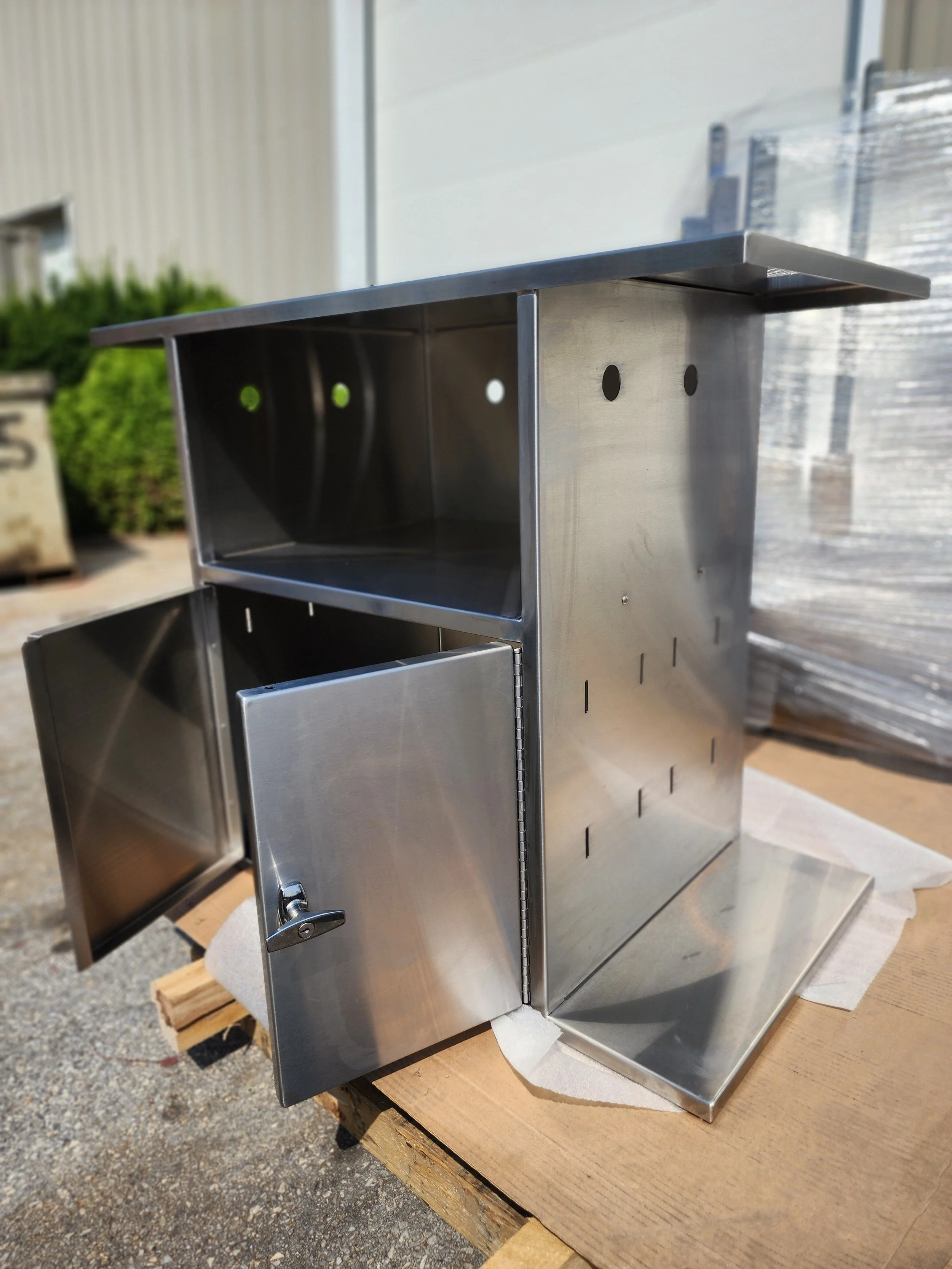
A large part of stackup issues can be traced to how bend calculations relate to a shop’s actual press brake tooling. That’s why a detailed, comprehensive drafting protocol is so important in our process at Baillie Fabricating & Welding.
The flat pattern should be created around real K-factors and bend radii from the shop’s actual conditions. We share our shop’s K-factors and radii with customers, and we offer design guidance when needed so the finished part matches the intent of the drawing. You can download our shop’s K-factor tables below:
A shop can invest in advanced equipment and software, but if the drafting does not match reality, the process will still produce poor results.
Real-World Example: Aluminum Parts
One recent project illustrates how this makes a difference. Aluminum and stainless steel behave differently, so both require their own bend calculations in drafting. Aluminum is also somewhat less predictable in forming, and deviations can sometimes be more common.
In cases like that, a test bend with aluminum parts can make a significant difference in determining if calculation adjustments will be necessary. If the parts are already cut, we may be able to make a forming adjustment at the press brake to compensate. If the issue is caught even earlier, the team can go back to the design stage and refine the calculations before the rest of the job moves forward. Either way, catching the issue early saves time and reduces waste.
We Reduce Stackup With Better Guidance
Tolerance stackup cannot be eliminated entirely, but both a shop and designers can help manage it to prevent issues. If you’re creating a design for use at Baillie Fabricating & Welding, it should use standard nominal material thickness, our K-factors, and our bend radii. With those inputs, it becomes easier to achieve accurate parts and avoid rework.
If you need to collaborate on optimizing your design, contact our Pennsylvania metal fabrication shop or request a quote today!