From Quote to Delivery, Tips for Fabrication Success at Every Stage
At Baillie Fabricating and Welding, we take pride in working with customers as true partners throughout a project. That includes providing input on your design, but our guidance also goes beyond the typical scope of design for manufacturability (DFM). Whenever possible, we offer help at every stage, starting with quoting and moving all the way through delivery.
Here are 9 recommendations that can help you control your costs and achieve better results.
Provide a 3D Model as Well as a 2D Drawing
When you submit an RFQ, we need at minimum a dimensioned 2D drawing. But a 3D model makes it easier to ensure good results and give accurate quotes; for instance, with a 3D model, we can see how a part will work and understand how it fits into an assembly.
If you only have a 2D drawing, we may need to create a 3D model before fabrication. We can help with that task with our CAD modeling services.
Select Material Based on Priorities (And We Can Offer Suggestions)
Aluminum, stainless steel, and carbon steel are all common options in our shop; each has different advantages for different use cases, and we’re happy to talk through them with you. Designers sometimes have a familiar material they default to, but in some cases another option could meet the project’s requirements at a lower cost.
Application requirements also matter. Stainless steel may be appropriate for equipment used in a food-grade freezer, for instance, because of its corrosion resistance. But for some higher-volume applications, galvanized steel might provide enough protection at a lower cost. We can help you understand the tradeoffs.
Use Standard Material Thickness
We see a lot of drawings that specify an unusual thickness or carry thickness dimensions to more decimal places than standard sheet and plate tolerances can support. Sheet and plate are generally sold in standard nominal thicknesses and may vary within established mill tolerances.
Whenever possible, design around standard nominal thicknesses. Nonstandard material may be available, but it typically costs more and can significantly extend lead times.
Decide on Your Finish Early, and Plan Around It
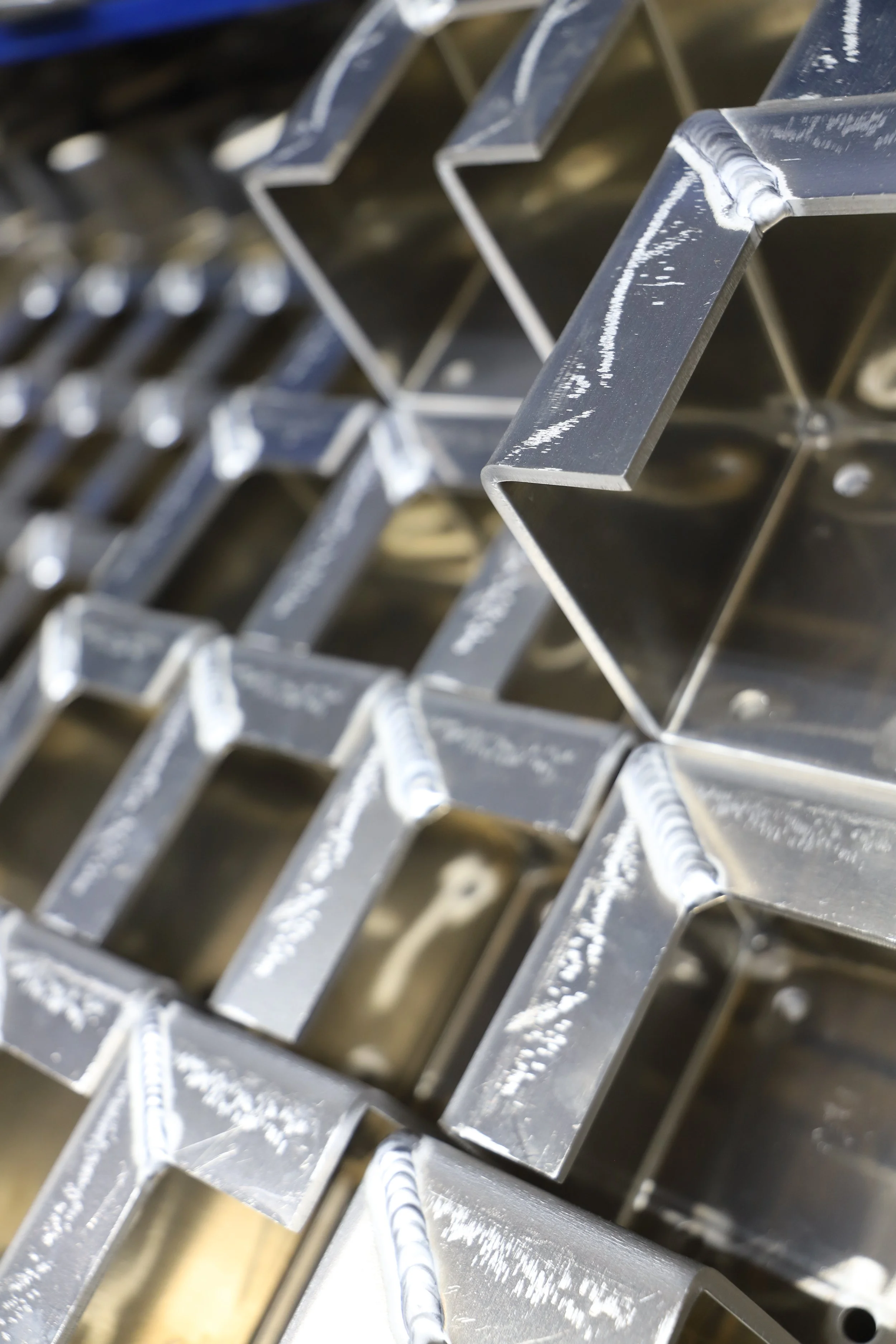
Your finishing choice should influence a variety of other decisions in your sheet metal fabrication project. Planning around it could help you find savings opportunities.
For example, customers sometimes request powder coating for stainless steel parts. The powder coating might provide enough corrosion protection for the part, so we sometimes ask if they’d instead want to use powder coated carbon steel to avoid the added cost of stainless steel.
Whenever Possible, Bend Instead of Welding
One of the most valuable sheet metal DFM principles is to opt for bends rather than welded joints whenever that is a possibility. Forming often requires less labor and produces less heat-related distortion, ultimately resulting in more consistent parts. A continuous bend may also create a stronger and cleaner part than joining separate pieces.
Leave Enough Space Between Bends
Bends positioned too close together can be difficult or impossible to produce with standard press brake tooling. Custom tooling may make certain geometries possible, but it adds cost and lead time.
Narrow channels and U-shaped parts need close attention because the vertical legs can interfere with the tooling as the second bend is formed. As a general starting point, Baillie recommends making the bottom width of a U-shaped part greater than the height of its vertical legs. For example, one-inch legs would typically require a bottom width greater than one inch.
This is only a rule of thumb. The dimensions that can be formed depend on a variety of different factors; talk to us to get specific recommendations for your part.
Include Complete Weld and Finishing Callouts
On your drawings, identify the required weld size, type, location, and continuity, along with any special process or filler-metal requirements. Also specify whether welds may remain visible or must be ground, blended, or made nearly invisible. These details affect labor and pricing, so defining them upfront supports an accurate quote.
Be Clear About Fastener Choices
Hardware like rivet nuts, weld studs, PEM hardware, threaded holes, nuts, and bolts each offer different benefits that vary depending on a part’s needs. Specify the required fastener type, size, material, and location so we can confirm the design will function as you want before sourcing the correct hardware. If you have flexibility, we can help identify hardware that will work best for your part’s function and manufacturability.
Plan Delivery from the Start, Including Kitting
Shipping and packaging may be far from a customer’s mind during the quoting phase, but the transportation method can affect how finished parts need to be protected and organized.
Let us know early how your finished parts will be transported, because this may alter our packaging strategy. Parts being sent on a large freight truck, for instance, may require more protection than with a small local delivery service.
Identify any kitting requirements as well. Baillie can separate and label hardware, group related components, and include assembly instructions for an additional fee. Planning these services early helps us deliver parts in the form your team needs.
Start Your Project With the Right Guidance
Baillie Fabricating and Welding wants every customer to receive the best possible value from their project, and that’s why we’re willing to advise on any decisions you’re struggling with. Contact us for practical DFM guidance, or request a quote to get started.