Sheet Metal Hems at Baillie Fab: Open vs. Closed and How to Choose
Hems are common features in sheet metal fabrication. They’re made by folding an edge back over the sheet, typically to cover a sharp cut edge and add rigidity. But hems come in several styles, and the one you choose can affect your part's appearance and cost.
The two most common are open and closed hems. Knowing the difference can help you specify an edge that does its job without adding unnecessary cost to your project.
What Is an Open Sheet Metal Hem?
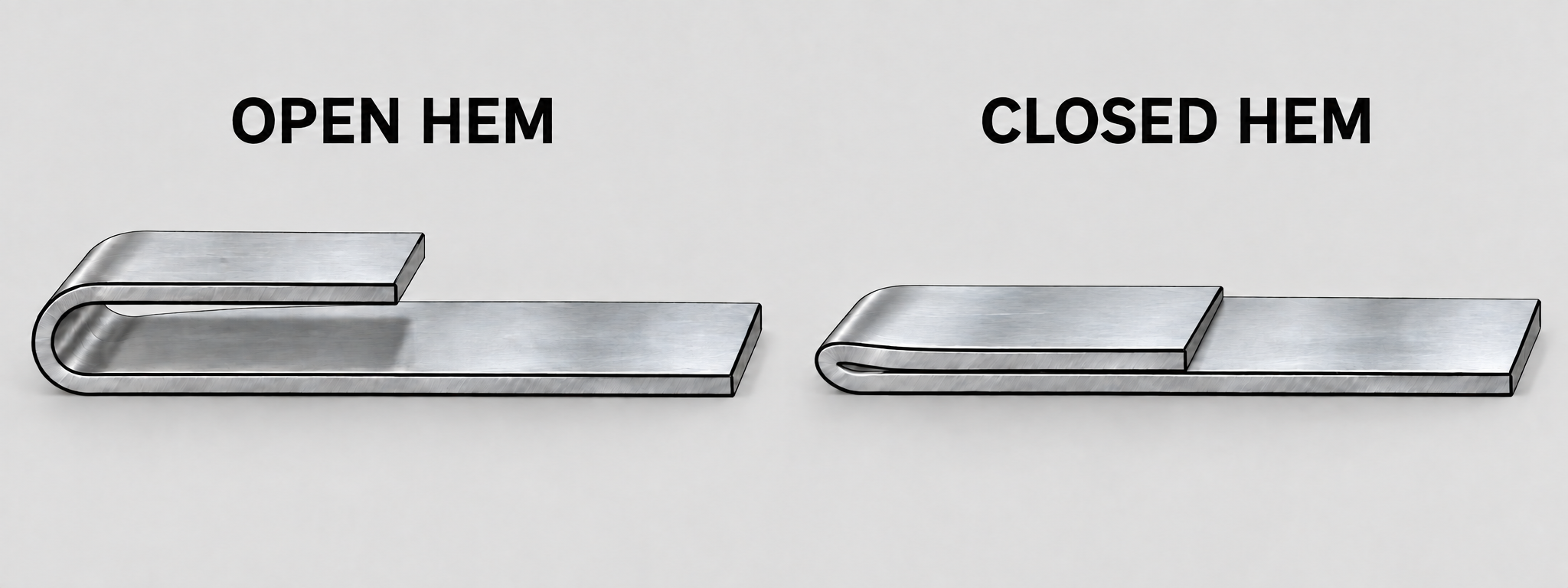
An open hem folds the edge back 180 degrees while leaving a gap between the returned edge and the main sheet. It hides the sharp cut edge and reinforces it, but the two layers aren’t pressed fully together. Depending on the design, the fold can also have functionality; it may hook over another component or work with a second hem to form a simple latch.
At Baillie Fabricating & Welding, open hems are the most common choice among our customers. Because the return does not have to be flattened, an open hem takes less forming force and can usually be made with standard tooling. It can also be a better option when the material is too thick or difficult to form into a closed hem.
What Is a Closed Sheet Metal Hem?
A closed hem is folded back and pressed flat against the main sheet. This doubled edge has a flatter profile and greater rigidity than an open hem. Customers may prefer closed hems for a variety of reasons, including appearance and stiffness.
The flatness of closed hems can be important in industries like food processing and pharmaceutical equipment. A closed hem reduces the open space where bacteria can collect and survive. If the part has sanitary requirements, closed hems may be the right choice.
Closed hems require more force to flatten and may require specialized tooling. That can increase cost, especially if a manufacturer doesn’t already have the necessary tooling.
Closed hems also present a cracking risk. As material gets thicker, the tight fold becomes harder to produce and may crack, particularly with certain materials. Some aluminum grades, for instance, are prone to cracking, so a softer grade of aluminum may be recommended if a closed hem is required.
For material thicker than roughly 11 gauge, a closed hem can become extremely difficult to create because of the tonnage required. If your part is near that range, we can look at the specific material before making a recommendation.
Choosing Between Open and Closed Hems
When you’re making your decision, start by considering the edge’s purpose. If you only need to cover a sharp edge and add stiffness, an open hem may be sufficient while costing less. If the part needs a flatter profile or greater rigidity, a closed hem may be worth it, provided the material can handle it.
Beyond Open vs. Closed
Open and closed hems are the most popular for many applications, but they are not the only options. A teardrop hem, for example, leaves a rounded pocket at the fold instead of flattening it completely.
We have also handled requests for teardrops and other specialized hems, but they’re less common in our shop. If your design calls for a particular edge shape, our team can review it with you to determine whether we can produce it or whether another option could work.
Discuss Your Sheet Metal Design With Baillie
Baillie Fabricating & Welding can produce open and closed hems when they are appropriate for the part. Request a quote or send your drawing to our sheet metal shop, and we’ll help you understand your options. We want to make sure we quote a design that is practical to fabricate.